
- MCom (Master of Commerce) Overview.
- 1. Overview of MCom (Master of Commerce)
- 2. MCom Course Duration and Fees
- 3. MCom Admission 2026
- 4. MCom Syllabus and Specializations
- 5. Scope and Career Opportunities After MCom
- Frequently Asked Questions (FAQ) – MCom (Master of Commerce)
- 1. What is MCom?
- 2. What is the duration of the MCom course?
- 3. What are the eligibility criteria for MCom Admission 2026?
- 4. What are the typical fees for MCom?
- 5. Is there an entrance exam for MCom?
- 6. What subjects are included in the MCom syllabus?
- 7. Which specializations are available in MCom?
- 8. What is the scope after MCom?
- 9. What job roles can MCom graduates pursue?
- 10. Can I get a government job after MCom?
MCom (Master of Commerce) Overview.
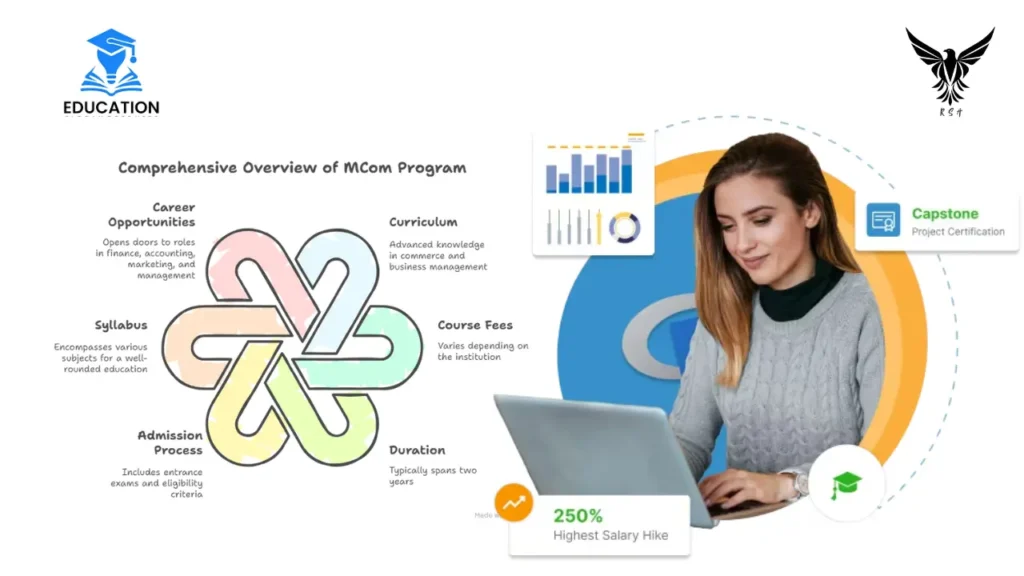
MCom (Master of Commerce) is a higher education that is offered to the students who want to acquire higher knowledge in commerce, finance, business management, accounting, and economics. It increases the level of analytical, managerial and research skills needed in the corporate and financial world. The program is suitable to the graduates of BCom, BBA, BAF, BBI, or BA Economics and incorporates aspects of both theory and practical hands-on, which gives graduates a good preparation to their careers and higher studies such as CA, CMA, CFA, PhD, and MBA. With the growing industries and complex financial systems, the importance and need of commerce professionals is ever increasing thus MCom is a very useful degree. MCom (Master of Commerce)
1. Overview of MCom (Master of Commerce)
| Aspect | Details |
|---|---|
| Full Form | Master of Commerce (MCom) |
| Level | Postgraduate |
| Focus Areas | Commerce, Finance, Accounting, Economics, Business Management |
| Ideal For | BCom, BBA, BAF, BBI, BA Economics graduates |
| Skills Developed | Analytical skills, managerial abilities, research skills |
| Purpose | Prepares students for corporate, financial, and academic roles |
| Further Study Options | CA, CMA, CFA, MBA, PhD MCom (Master of Commerce) |
| Industry Demand | High demand due to expanding corporate & financial sectors |
MCom Course Duration and Fees.
The length of the MCom course is typically 2 years with four semesters, whilst other universities are trimester based. The students are free to take the program in regular, distance, or online programs depending on their personal choice and convenience. The costs of the MCom course differ widely depending on the school and the form of studies. Government universities typically cost 10,000 to 30,000, whereas in private colleges it costs 40,000 to 1,50,000. MCom programs are also becoming popular online because it is cheap with the entire course costing between 80,000 and 20,000 rupees. MCom (Master of Commerce)
2. MCom Course Duration and Fees
| Aspect | Details |
|---|---|
| Course Duration | 2 years (4 semesters) |
| Study Modes | Regular, Distance, Online |
| Government College Fees | ₹10,000 – ₹30,000 |
| Private College Fees | ₹40,000 – ₹1,50,000 |
| Online MCom Fees | ₹20,000 – ₹80,000 |
| Semester Pattern | Semester or Trimester (varies by university) |
MCom Admission 2026
In the case of MCom Admission 2026, the candidates should have an eligibility requirement and the common eligibility norm is to have a Bachelor of Commerce degree with at least 45-50 percent marks. Several universities use merit-based admissions, whereas there are also universities which use entrance exams, including CUET PG, DUET, BHU PET, or institutional-based tests. The steps involved in the admission process will be online registration, submission of applications, uploading of documents, merit list or entrance results, counseling (where required) and paying of fees. The aspirants will have to visit the university websites frequently to see announcements, deadlines and exam schedules in order to make sure they are able to join the 2026 academic session. MCom (Master of Commerce)
3. MCom Admission 2026
| Aspect | Details |
|---|---|
| Eligibility | Bachelor’s degree in Commerce/related fields with 45–50% marks |
| Admission Type | Merit-based / Entrance exam-based |
| Common Entrance Exams | CUET PG, DUET, BHU PET, university-specific exams |
| Admission Steps | Registration → Application → Document Upload → Merit List/Exam Results → Counseling (if any) → Fee Payment |
| Admission Mode | Mostly online application |
| Academic Session | 2026–27 |
MCom Syllabus and Specializations.
MCom syllabus is an all round course that reinforces the higher learning concepts in commerce and business. Basic topics are Advanced Accounting,Managerial Economics, Business Law, Income Tax, Marketing Management, HRM, Auditing, Cost Accounting, Banking and Financial Systems and Research Methodology. Second-year students are also allowed to choose such specializations as Finance, Accounting, Marketing, Taxation, Economics, Banking and Insurance, International Business, or Entrepreneurship. The curriculum is also based on applied training, internship, case study, presentation, and dissertation projects, which enable students to be industry ready.
4. MCom Syllabus and Specializations
| Aspect | Details |
|---|---|
| Core Subjects | Advanced Accounting, Managerial Economics, Business Law, Income Tax, Marketing, HRM, Auditing, Cost Accounting, Banking & Finance, Research Methodology |
| Specializations | Finance, Accounting, Marketing, Taxation, Economics, HRM, Banking & Insurance, International Business, Entrepreneurship |
| Learning Components | Case studies, seminars, internships, presentations, dissertations |
| Curriculum Focus | Theory + Practical exposure + Research-based learning |
Scope and Career Opportunities.
MCom is a very broad field that has provided a great employment opportunity in various fields like banking, insurance, taxation, auditing, education, corporate management and financial services. The graduates are allowed to work as Accountants, Financial Analysts, Tax Consultants, Auditors, Investment Banker, Stock Market Analysts, Finance Executives, and credit analysts among others. Academically interested persons can also take up a career as Lecturers or Professors particularly after passing UGC NET. Also, MCom graduates are properly ready to government and competitive exams such as RBI Grade B, NABARD, UPSC, SSC and bank exams. It has a solid base and high employability, thus the MCom degree is a long-term career development, greater pay opportunities, and both domestic and international market choices.
5. Scope and Career Opportunities After MCom
| Aspect | Details |
|---|---|
| Major Sectors | Banking, Finance, Insurance, Taxation, Auditing, Corporate Management, Education |
| Job Roles | Accountant, Financial Analyst, Tax Consultant, Auditor, Investment Banker, Stock Analyst, Finance Executive, Credit Analyst |
| Academic Career | Lecturer, Assistant Professor (after UGC NET) |
| Competitive Exams | RBI Grade B, NABARD, UPSC, SSC, IBPS, Banking Exams |
| Career Benefits | High job demand, strong salary growth, opportunities in national & international industries |
Frequently Asked Questions (FAQ) – MCom (Master of Commerce)
1. What is MCom?
MCom is a 2-year postgraduate degree focusing on commerce, finance, accounting, economics, and business management.
2. What is the duration of the MCom course?
The MCom course duration is 2 years, divided into four semesters.
3. What are the eligibility criteria for MCom Admission 2026?
Candidates must have a bachelor’s degree in Commerce or related fields with 45–50% marks.
4. What are the typical fees for MCom?
Fees range from ₹10,000–₹30,000 in government colleges and ₹40,000–₹1,50,000 in private universities.
5. Is there an entrance exam for MCom?
Some universities conduct exams like CUET PG or DUET, while others offer merit-based admission.
6. What subjects are included in the MCom syllabus?
Subjects include Advanced Accounting, Taxation, Business Law, Marketing, HRM, Banking & Finance, and Research Methodology.
7. Which specializations are available in MCom?
Specializations include Finance, Accounting, Marketing, Taxation, Economics, HRM, and International Business.
8. What is the scope after MCom?
Graduates can work in banking, taxation, finance, auditing, corporate management, and academics.
9. What job roles can MCom graduates pursue?
Roles include Accountant, Financial Analyst, Tax Consultant, Auditor, Investment Banker, and Business Analyst.
10. Can I get a government job after MCom?
Yes, you can apply for RBI Grade B, NABARD, SSC, UPSC, and banking exams.