
BBA: A Comprehensive Guide (2026)
This document provides a comprehensive overview of the Bachelor of Business Administration (BBA) degree. It covers the full form, duration, admission process for 2026, top colleges offering the program, a typical syllabus, potential salary expectations, and the overall scope and career prospects associated with a BBA degree. This guide is intended for prospective students considering pursuing a BBA and seeking detailed information to make an informed decision.
BBA: Full Form
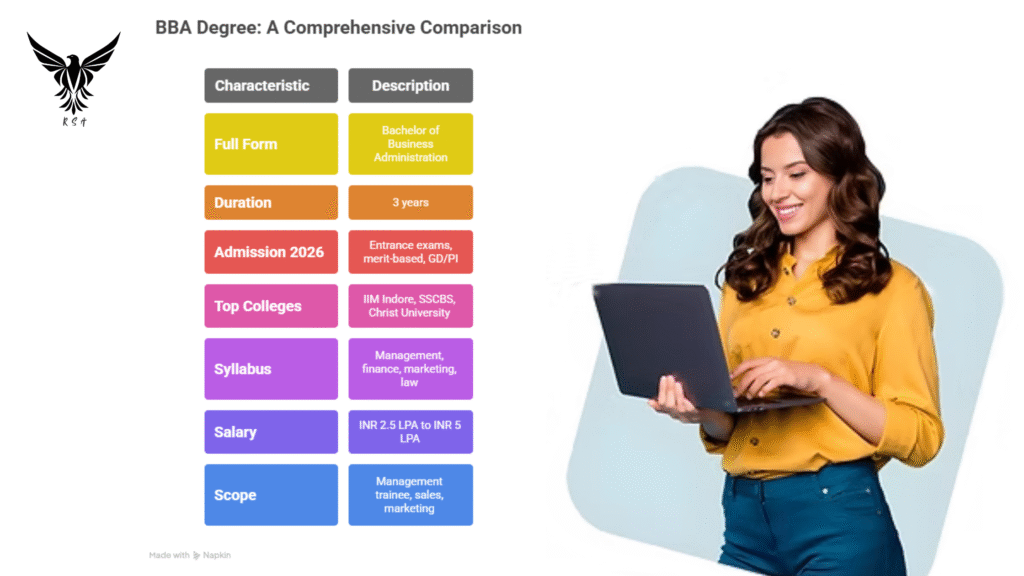
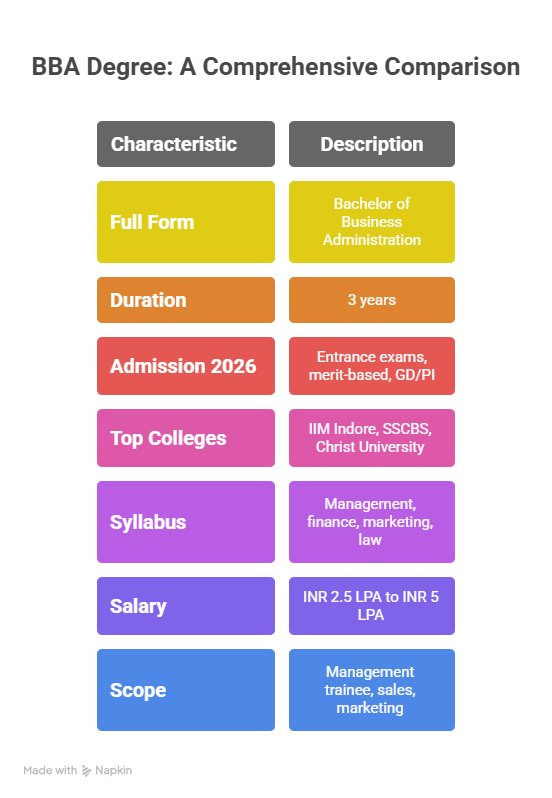
BBA stands for Bachelor of Business Administration. It is an undergraduate degree program designed to provide students with a foundational understanding of business principles and management practices.
Duration
The standard duration of a BBA program is 3 years. This is typically divided into six semesters, with each semester lasting approximately six months. Some institutions may offer accelerated programs or variations in the semester structure, but the core curriculum is generally completed within this timeframe.
Admission 2026
Admission to BBA programs for the academic year 2026 will likely follow similar patterns as previous years, with some potential adjustments based on evolving educational policies and institutional preferences. Here’s a breakdown of the typical admission process:
Eligibility Criteria
- Educational Qualification: Candidates must have completed their 10+2 (or equivalent) from a recognized board with a minimum aggregate percentage. The specific percentage requirement varies from college to college, but it generally ranges from 45% to 60%.
- Subject Requirements: While most BBA programs do not have strict subject requirements at the 10+2 level, having studied commerce or mathematics can be advantageous. Some colleges may give preference to students with these backgrounds.
- Age Limit: There is usually no upper age limit for BBA programs.
Admission Process
The admission process typically involves one or more of the following:
- Entrance Exams: Many top BBA colleges conduct their own entrance exams to assess candidates’ aptitude, reasoning skills, and general knowledge. Some popular entrance exams include:
- DU JAT (Delhi University Joint Admission Test): For admission to BBA programs offered by Delhi University affiliated colleges. (Note: DU JAT has been replaced by CUET)
- CUET (Common University Entrance Test): A national-level entrance exam for admission to various undergraduate programs, including BBA, in central universities and other participating institutions.
- NPAT (NMIMS Programs After Twelfth): Conducted by NMIMS University for admission to its BBA programs.
- SET (Symbiosis Entrance Test): Conducted by Symbiosis International University for admission to its affiliated colleges.
- IPMAT (Integrated Program in Management Aptitude Test): While primarily for integrated management programs, some colleges may accept IPMAT scores for BBA admissions.
- Merit-Based Admission: Some colleges offer admission based solely on the candidate’s performance in their 10+2 examinations. The cutoff percentages for merit-based admission can be quite high, especially for prestigious institutions.
- Group Discussion (GD) and Personal Interview (PI): After clearing the entrance exam or meeting the merit-based cutoff, candidates may be required to participate in a group discussion and/or a personal interview. These rounds assess their communication skills, leadership potential, and overall suitability for the program.
Key Dates and Application Process
- Keep an eye on the official websites of the colleges you are interested in for announcements regarding admission dates, application deadlines, and exam schedules.
- The application process is usually online. Fill out the application form carefully and provide all the required information accurately.
- Pay the application fee through the prescribed mode.
- Download your admit card (if applicable) and appear for the entrance exam on the scheduled date.
Top BBA Colleges
Here’s a list of some of the top colleges in India:
- Indian Institute of Management (IIM), Indore (Integrated Program in Management – IPM)
- Indian Institute of Management (IIM), Rohtak (Integrated Program in Management – IPM)
- Shaheed Sukhdev College of Business Studies, Delhi University
- Deen Dayal Upadhyaya College, Delhi University
- Keshav Mahavidyalaya, Delhi University
- Narsee Monjee College of Commerce & Economics, Mumbai
- Christ University, Bangalore
- Loyola College, Chennai
- Symbiosis Centre for Management Studies (SCMS), Pune
- Amity University, Noida
Note: This is not an exhaustive list, and the ranking of colleges may vary depending on the source.
Syllabus
The syllabus is designed to provide a broad understanding of various business functions and management principles. A typical BBA syllabus includes the following subjects:
Year 1:
- Principles of Management
- Business Mathematics
- Financial Accounting
- Business Economics
- Business Communication
- Computer Applications in Business
Year 2:
- Marketing Management
- Human Resource Management
- Financial Management
- Operations Management
- Business Statistics
- Organizational Behavior
Year 3:
- Strategic Management
- Entrepreneurship Development
- Business Law
- Management Information Systems
- Electives (e.g., International Business, Retail Management, Digital Marketing)
- Project Work/Internship
Note: The specific subjects and their sequence may vary from college to college.
Salary
The salary of a graduate depends on several factors, including:
- College Reputation: Graduates from top-tier colleges tend to command higher salaries.
- Skills and Experience: Internships, projects, and relevant skills can significantly boost earning potential.
- Job Role: Different job roles offer varying salary ranges.
- Industry: Some industries, such as finance and consulting, generally offer higher salaries than others.
- Location: Salaries may vary depending on the city or region.
As a general estimate, a fresh graduate can expect to earn an average salary ranging from INR 2.5 LPA to INR 5 LPA. With experience and further education (such as an MBA), the salary can increase significantly.
Scope
A degree opens up a wide range of career opportunities in various sectors. Some popular career paths for graduates include:
- Management Trainee: Entry-level positions in various departments, such as marketing, finance, and operations.
- Sales Executive: Responsible for generating sales and managing customer relationships.
- Marketing Executive: Involved in planning and executing marketing campaigns.
- Human Resources (HR) Assistant: Supports HR functions, such as recruitment and employee relations.
- Finance Assistant: Assists with financial tasks, such as accounting and budgeting.
- Business Development Executive: Focuses on identifying and pursuing new business opportunities.
- Entrepreneurship: A degree provides a solid foundation for starting and managing one’s own business.
Furthermore, a degree serves as an excellent foundation for pursuing higher education, such as an MBA (Master of Business Administration), which can significantly enhance career prospects and earning potential. Other postgraduate options include specialized master’s degrees in fields like finance, marketing, or human resources.
BBA FAQs
BBA stands for Bachelor of Business Administration.
The BBA program duration is 3 years.
Admission is done through entrance exams like IPU CET, CUET, SET, NPAT, or merit-based selection in many colleges.
Top colleges include: IIM Indore (IPM), NMIMS, DU colleges, Christ University, Symbiosis, Amity, and Loyola College.
Subjects include: Accounting, Marketing, HRM, Business Economics, Finance, Business Law, Entrepreneurship, Digital Marketing, and Management Concepts.
Average salary ranges from ₹3–8 LPA, depending on the job role, college, and skills.
BBA graduates can work in HR, marketing, finance, banking, sales, operations, management, or pursue MBA for better opportunities.