What is Law? : A Comprehensive Guide to Courses, Colleges, and Career Paths in India
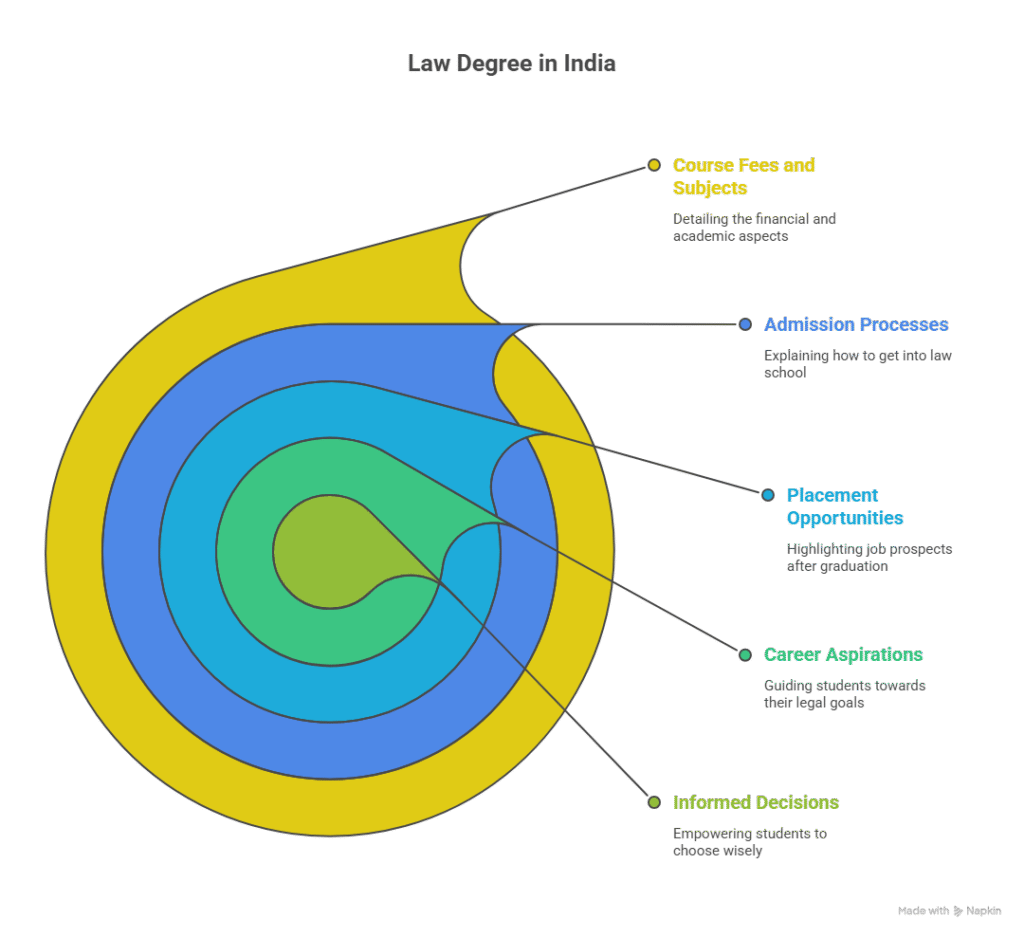
This document provides a comprehensive overview of pursuing a law degree in India. It covers essential aspects such as course fees, subjects studied, top colleges, admission processes, scope, and placement opportunities. This guide aims to assist prospective law students in making informed decisions about their legal education and career aspirations.
Course Fees for Law Programs in India (2026 Projection)
Law program fees in India vary significantly depending on the type of institution (government vs. private), the program level (undergraduate vs. postgraduate), and the specific college’s reputation and infrastructure. Here’s a projected overview of course fees for 2026:
- Government Law Colleges: These colleges typically offer the most affordable options. Expect annual fees ranging from INR 10,000 to INR 50,000.
- Private Law Colleges: Private institutions generally have higher fees. Annual fees can range from INR 50,000 to INR 3,00,000 or more.
- National Law Universities (NLUs): NLUs are autonomous institutions and tend to have higher fees than government colleges but are often considered more affordable than top-tier private colleges. Annual fees can range from INR 1,50,000 to INR 3,00,000.
Note: These are projected figures for 2026. Actual fees may vary. It’s crucial to check the official websites of individual colleges for the most up-to-date information.
Subjects Studied in a Law Degree
The curriculum for a law degree in India is comprehensive and covers a wide range of legal subjects. Here are some core subjects typically included:
- Constitutional Law: The fundamental principles and structure of the Indian Constitution.
- Criminal Law: The study of offenses against society and their punishments.
- Contract Law: The formation, interpretation, and enforcement of contracts.
- Tort Law: Civil wrongs that cause harm to another person.
- Property Law: The rights and interests related to real and personal property.
- Family Law: Laws governing marriage, divorce, inheritance, and adoption.
- Company Law: The legal framework for the formation, operation, and dissolution of companies.
- Environmental Law: Laws related to the protection of the environment.
- Intellectual Property Law: Laws protecting patents, trademarks, copyrights, and trade secrets.
- International Law: Laws governing relations between nations.
- Civil Procedure Code (CPC): The rules and procedures for civil court proceedings.
- Criminal Procedure Code (CrPC): The rules and procedures for criminal court proceedings.
- Evidence Law: The rules governing the admissibility of evidence in court.
In addition to these core subjects, law students often have the opportunity to specialize in specific areas of law through elective courses.
Top Law Colleges in India
India boasts several prestigious law colleges that consistently rank among the best in the country. Here are some of the top institutions:
- National Law School of India University (NLSIU), Bangalore: Widely regarded as the premier law school in India.
- National Law University (NLU), Delhi: A highly respected NLU known for its rigorous academic program.
- NALSAR University of Law, Hyderabad: Another top-tier NLU with a strong focus on research and academic excellence.
- The WB National University of Juridical Sciences (NUJS), Kolkata: A leading NLU with a strong emphasis on social justice.
- National Law University, Jodhpur: A well-regarded NLU with a focus on corporate law and intellectual property law.
- Symbiosis Law School, Pune: A prominent private law school known for its industry connections.
- Jindal Global Law School (JGLS), Sonipat: A leading private law school with a global perspective.
- Faculty of Law, Delhi University: A historic and respected law faculty within Delhi University.
- Government Law College, Mumbai: One of the oldest and most prestigious government law colleges in India.
- ILS Law College, Pune: A renowned law college with a strong alumni network.
Admission to Law Programs in India
Admission to law programs in India typically involves entrance exams, academic merit, and sometimes interviews. Here’s an overview of the admission process:
- Entrance Exams:
- CLAT (Common Law Admission Test): The most important entrance exam for admission to most NLUs.
- AILET (All India Law Entrance Test): Conducted by NLU Delhi for admission to its programs.
- LSAT—India: A standardized test used by some private law schools.
- State-Level Entrance Exams: Some states conduct their own entrance exams for admission to law colleges within the state.
- Academic Merit: Some colleges may consider academic performance in qualifying examinations (e.g., 10+2) as part of the admission criteria.
- Interviews: Some colleges may conduct interviews to assess candidates’ communication skills, aptitude for law, and overall suitability for the program.
Note: Specific admission criteria and procedures vary from college to college. It’s essential to check the official websites of individual institutions for detailed information.
Scope of a Law Degree in India
A law degree offers a wide range of career opportunities in India. Here are some of the most common career paths:
- Litigation: Representing clients in courts of law.
- Corporate Law: Advising companies on legal matters related to business operations.
- Legal Consulting: Providing legal advice to individuals and organizations.
- Government Service: Working as a legal officer in government departments or agencies.
- Judiciary: Becoming a judge in the lower or higher courts.
- Academia: Teaching law at universities and colleges.
- Legal Journalism: Reporting on legal issues and court proceedings.
- Alternative Dispute Resolution (ADR): Practicing mediation, arbitration, or other forms of ADR.
- Human Rights Law: Working to protect and promote human rights.
- International Law: Working for international organizations or law firms specializing in international law.

Placements after a Law Degree
Placement opportunities for law graduates in India vary depending on the college’s reputation, the student’s academic performance, and their skills and experience.
- NLUs and Top Private Law Schools: These institutions typically have strong placement records, with many graduates securing jobs in top law firms, corporations, and government organizations.
- Other Law Colleges: Placement opportunities may be more limited at other law colleges, but graduates can still find employment through networking, internships, and independent job searches.
Common Recruiters:
- Law Firms: Amarchand & Mangaldas & Suresh A. Shroff & Co., AZB & Partners, Khaitan & Co., Trilegal, etc.
- Corporations: Reliance Industries, Tata Group, HDFC Bank, ICICI Bank, etc.
- Government Organizations: Various government departments and agencies.
- Non-Governmental Organizations (NGOs): Organizations working in areas such as human rights, environmental protection, and legal aid.
Note: Salary packages for law graduates vary depending on the employer, the location, and the candidate’s experience. Graduates from top law schools typically command higher salaries.
In conclusion, pursuing a law degree in India can be a rewarding and fulfilling career path. By carefully considering the factors outlined in this guide, prospective law students can make informed decisions and embark on a successful legal career.
Private colleges: ₹1–4 lakh/year.