
Engineering in India: A Comprehensive Guide for 2026
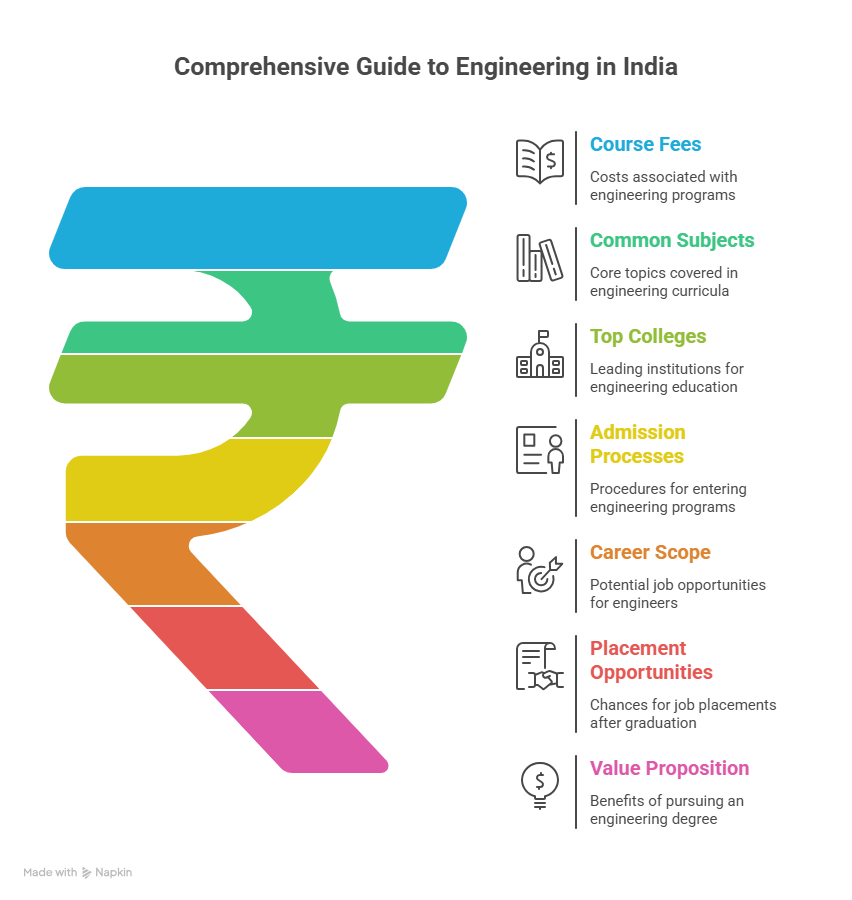
This document provides a comprehensive overview of pursuing an engineering degree in India, focusing on key aspects relevant to prospective students in 2026. It covers course fees, common subjects, top colleges, admission processes, career scope, placement opportunities, and the overall value proposition of an engineering degree in the Indian context. This guide aims to equip aspiring engineers with the necessary information to make informed decisions about their academic and professional futures.
Course Fees for Engineering Programs in 2026
Engineering course fees in India vary significantly depending on the type of institution (government, private, deemed university), the specific engineering branch, and the location of the college.
- Government Colleges: Government-funded colleges typically have the lowest fees, ranging from INR 20,000 to INR 1,00,000 per year. These colleges are highly competitive and offer excellent value for money.
- Private Colleges: Private colleges generally have higher fees, ranging from INR 80,000 to INR 5,00,000 per year. The fees can vary widely based on the college’s reputation, infrastructure, and faculty.
- Deemed Universities: Deemed universities often have the highest fees, potentially exceeding INR 3,00,000 to INR 8,00,000 per year. These institutions often offer specialized programs and boast advanced research facilities.
Factors Influencing Fees:
- Accreditation: Colleges with accreditation from bodies like the National Board of Accreditation (NBA) may charge higher fees due to their adherence to quality standards.
- Infrastructure: Colleges with state-of-the-art infrastructure, including well-equipped labs, libraries, and hostels, tend to have higher fees.
- Faculty: Colleges with experienced and highly qualified faculty members may charge higher fees.
- Location: Colleges located in metropolitan cities often have higher fees compared to those in smaller towns or rural areas.
Common Subjects in Engineering Curricula
While the specific subjects vary depending on the branch, some core subjects are common across most disciplines:
- Mathematics: Calculus, Linear Algebra, Differential Equations, Probability and Statistics.
- Physics: Mechanics, Electromagnetism, Optics, Modern Physics.
- Chemistry: Organic Chemistry, Inorganic Chemistry, Physical Chemistry.
- Computer Science: Programming Fundamentals, Data Structures and Algorithms, Database Management Systems.
- Engineering Drawing/Graphics: Introduction to CAD/CAM.
- Basic Electronics: Circuit Analysis, Digital Electronics.
- Communication Skills: Technical Writing, Presentation Skills.
- Engineering Mechanics: Statics, Dynamics.
- Thermodynamics: Basic concepts and applications.
Branch-Specific Subjects:
- Computer Science Engineering: Operating Systems, Computer Networks, Artificial Intelligence, Machine Learning, Software Engineering.
- Mechanical Engineering: Fluid Mechanics, Heat Transfer, Manufacturing Processes, Machine Design, Thermodynamics.
- Electrical Engineering: Power Systems, Control Systems, Electrical Machines, Signal Processing, Microelectronics.
- Civil Engineering: Structural Analysis, Geotechnical , Transportation , Environmental , Hydraulics.
- Chemical Engineering: Mass Transfer, Heat Transfer, Chemical Reaction, Process Control.
Top Engineering Colleges in India
Identifying the “top” colleges is subjective and depends on various ranking methodologies. However, some consistently highly-ranked institutions include:
- Indian Institutes of Technology (IITs): IIT Bombay, IIT Delhi, IIT Madras, IIT Kanpur, IIT Kharagpur, IIT Roorkee, IIT Guwahati, IIT Hyderabad, IIT Gandhinagar, IIT Indore, IIT Patna, IIT Ropar, IIT Bhubaneswar, IIT Mandi, IIT Jodhpur, IIT Tirupati, IIT Palakkad, IIT (ISM) Dhanbad, IIT Bhilai, IIT Goa, IIT Jammu, IIT Dharwad.
- National Institutes of Technology (NITs): NIT Trichy, NIT Warangal, NIT Surathkal, NIT Rourkela, NIT Calicut, NIT Allahabad, NIT Durgapur, NIT Kurukshetra, NIT Jaipur, NIT Bhopal, NIT Nagpur, NIT Patna, NIT Silchar, NIT Hamirpur, NIT Jalandhar, NIT Srinagar, NIT Agartala, NIT Manipur, NIT Meghalaya, NIT Mizoram, NIT Nagaland, NIT Sikkim, NIT Arunachal Pradesh, NIT Delhi, NIT Goa, NIT Puducherry, NIT Uttarakhand.
- Other Reputable Institutions: Birla Institute of Technology and Science (BITS) Pilani, Vellore Institute of Technology (VIT) Vellore, Institute of Chemical Technology (ICT) Mumbai, Delhi Technological University (DTU), Netaji Subhas University of Technology (NSUT) Delhi, Jadavpur University Kolkata, Anna University Chennai, PSG College of Technology Coimbatore, RV College of Engineering Bangalore, Manipal Institute of Technology Manipal.
Admission Processes for Engineering Programs
Admission programs in India is primarily based on entrance examinations.
- JEE Main: This is the primary entrance exam for admission to NITs, IIITs, and other government-funded colleges. The top performers in JEE Main are eligible to appear for JEE Advanced.
- JEE Advanced: This is the entrance exam for admission to the IITs. It is considered one of the most challenging entrance exams in the world.
- State-Level Entrance Exams: Many states conduct their own entrance exams for admission to colleges within the state. Examples include MHT CET (Maharashtra), KCET (Karnataka), and WBJEE (West Bengal).
- Private College Entrance Exams: Some private colleges conduct their own entrance exams or accept scores from national-level exams. Examples include VITEEE (VIT Vellore), BITSAT (BITS Pilani), and SRMJEEE (SRM University).
Admission Criteria:
- Entrance Exam Score: The primary criterion for admission is the score obtained in the relevant entrance exam.
- Class 12 Marks: Some colleges may also consider the marks obtained in Class 12 examinations.
- Reservation Policies: Government colleges and some private colleges follow reservation policies for various categories, including Scheduled Castes (SC), Scheduled Tribes (ST), Other Backward Classes (OBC), and Economically Weaker Sections (EWS).
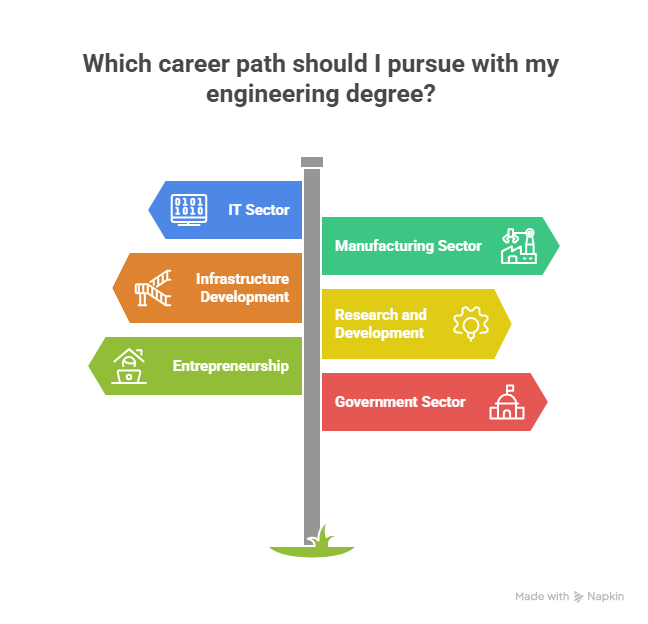
Scope of Engineering Degrees in India
The scope of engineering degrees in India remains vast and promising, driven by the country’s growing economy and technological advancements.
- IT Sector: Computer Science and related branches are highly sought after in the booming IT sector, with opportunities in software development, data science, artificial intelligence, and cybersecurity.
- Manufacturing Sector: Mechanical, Electrical, and Chemical eng are crucial for the manufacturing sector, contributing to production, automation, and process optimization.
- Infrastructure Development: Civil eng play a vital role in infrastructure development, including the construction of roads, bridges, buildings, and other essential infrastructure projects.
- Research and Development:
- graduates can pursue careers in research and development, contributing to innovation and technological advancements in various fields.
- Entrepreneurship: An
- degree provides a strong foundation for entrepreneurship, enabling graduates to start their own technology-based companies.
- Government Sector: Many government organizations and public sector undertakings (PSUs) recruit
- graduates for various roles.
Placements for Engineering Graduates
Placement opportunities for engineering graduates vary depending on the college, this branch, and the overall economic climate.
- Top Colleges: Top-tier engineering colleges like the IITs and NITs typically have excellent placement records, with a high percentage of students securing jobs in reputed companies.
- Core Branches: Core
- branches like Mechanical, Electrical, and Civil often have good placement opportunities in manufacturing, infrastructure, and energy sectors.
- IT and Computer Science: Computer Science and related branches consistently attract high-paying job offers from IT companies.
- Placement Trends: Placement trends can fluctuate based on industry demands and economic conditions. It is essential to research the placement records of specific colleges and branches before making a decision.
Factors Influencing Placements:
- College Reputation: Colleges with a strong reputation and industry connections tend to attract more companies for placements.
- Student Skills: Students with strong technical skills, communication skills, and problem-solving abilities are more likely to secure good placements.
- Industry Demand: The demand for specific
- branches can influence placement opportunities.
In conclusion, pursuing an
degree in India offers a wide range of opportunities for personal and professional growth. By carefully considering factors such as course fees, subjects, college rankings, admission processes, career scope, and placement opportunities, aspiring engineers can make informed decisions and embark on successful careers in their chosen fields.
Private Colleges: ₹1,00,000 – ₹4,00,000 per year
Top Universities (like IITs): approx ₹2,00,000 per year.
Branch subjects: Computer Science, Mechanical, Electrical, Electronics, Civil, IT, AI/ML, Robotics, Aeronautical, etc.
Practical: Labs, Projects, Internships.
• NIT Trichy, NIT Surathkal, NIT Warangal
• BITS Pilani, VIT, SRM, Manipal
• State government engineering colleges
• JEE Main (for NITs)
• JEE Advanced (for IITs)
• State exams (MHT-CET, KCET, WBJEE, etc.)
• Direct admission in many private colleges.
Average placements in good colleges: 4 LPA – 12 LPA
Companies: Google, TCS, Infosys, L&T, Amazon, Microsoft, Tesla (international), many more.