
PhD in Law: A Comprehensive Guide to Scope, Salary, Scholarships, Fees, and the AI-Driven Future
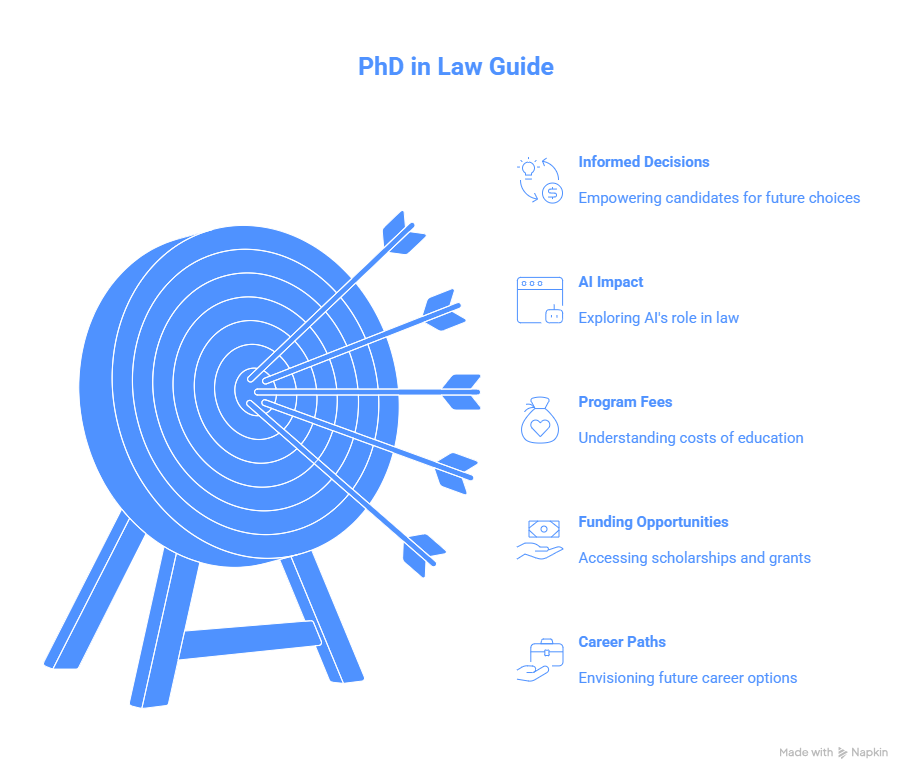
This document provides a comprehensive overview of pursuing a PhD in Law. It delves into the scope of legal research, potential career paths and salary expectations, available scholarships and funding opportunities, typical program fees, and the transformative impact of Artificial Intelligence (AI) on the legal profession and legal scholarship. This guide aims to equip prospective doctoral candidates with the necessary information to make informed decisions about their academic and professional futures. PhD in Law
What is a PhD in Law?
A Doctor of Philosophy (PhD) in Law is a postgraduate research degree that represents the highest level of academic qualification in the field of law. It involves original and significant research that contributes to the existing body of legal knowledge. Unlike professional law degrees like the Juris Doctor (JD) or Bachelor of Laws (LLB), a PhD in Law focuses on theoretical and analytical inquiry rather than practical legal skills. PhD in Law
Scope of Legal Research
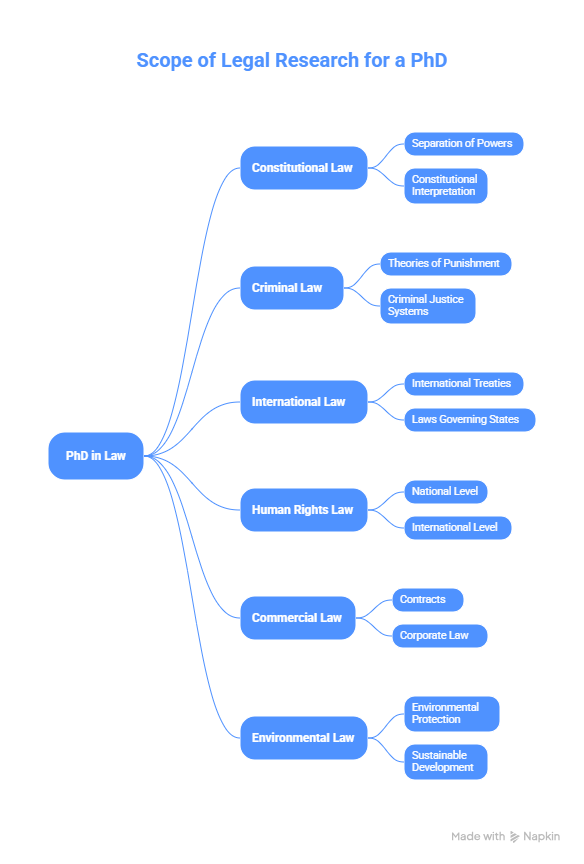
The scope of legal research for a PhD is incredibly broad and diverse. It can encompass virtually any area of law, including:
- Constitutional Law: Examining fundamental rights, separation of powers, and constitutional interpretation.
- Criminal Law: Analyzing criminal justice systems, theories of punishment, and specific criminal offenses.
- International Law: Investigating international treaties, organizations, and the laws governing relations between states.
- Human Rights Law: Exploring the protection and promotion of human rights at national and international levels.
- Commercial Law: Studying contracts, corporate law, intellectual property, and other aspects of business law.
- Environmental Law: Analyzing legal frameworks for environmental protection and sustainable development.
- Technology Law: Examining the legal implications of emerging technologies, such as artificial intelligence, blockchain, and cybersecurity.
- Legal History: Investigating the historical development of legal concepts, institutions, and systems.
- Legal Theory: Exploring philosophical and theoretical perspectives on law, justice, and legal reasoning.
- Comparative Law: Comparing and contrasting different legal systems around the world.
PhD research often involves interdisciplinary approaches, drawing on insights from fields such as sociology, political science, economics, philosophy, and history.
Career Paths and Salary Expectations
A PhD in Law opens doors to a variety of career paths, primarily in academia, research, and policy-making.
- Academia: The most common career path for PhD graduates is as a professor or lecturer at a university or law school. Academic positions involve teaching courses, conducting research, and publishing scholarly articles and books.
- Research: PhD graduates can also work as researchers at think tanks, research institutions, or government agencies. They conduct legal research, analyze policy issues, and contribute to the development of legal reforms.
- Policy-Making: A PhD in Law can be valuable for careers in government, international organizations, and non-governmental organizations (NGOs). Graduates can work as policy advisors, legal consultants, or advocates, contributing to the development and implementation of laws and policies.
- Legal Practice: While less common, some PhD graduates may choose to return to legal practice, bringing their research expertise to complex legal cases or specialized areas of law.
- Consulting: Legal PhDs are also sought after in consulting roles, particularly in areas requiring deep legal expertise and analytical skills. PhD in Law
Salary Expectations:
Salary expectations for PhD graduates in Law vary depending on the specific career path, experience, and location.
- Academia: Entry-level academic positions (assistant professor) in the US can range from $70,000 to $120,000 per year, while experienced professors can earn significantly more. Salaries in other countries may vary.
- Research: Research positions in think tanks and government agencies typically offer salaries ranging from $60,000 to $100,000 per year.
- Policy-Making: Salaries in policy-making roles can range from $50,000 to $90,000 per year, depending on the organization and level of responsibility.
- Legal Practice: Salaries for PhD graduates in legal practice can vary widely, depending on the type of law firm and area of specialization. PhD in Law
Scholarships and Funding Opportunities
Funding a PhD in Law can be a significant challenge, but numerous scholarships and funding opportunities are available.
- University Scholarships: Many universities offer scholarships and fellowships to PhD students based on academic merit. These scholarships may cover tuition fees, living expenses, or both.
- Government Funding: Government agencies in many countries provide funding for doctoral research in law. These grants may be awarded based on the research proposal’s quality and its potential impact on society.
- Private Foundations: Private foundations and charitable organizations often offer scholarships and grants to PhD students in specific areas of law, such as human rights, environmental law, or international law.
- Research Grants: PhD students can also apply for research grants to support their specific research projects. These grants may cover expenses such as travel, data collection, and conference attendance.
- Teaching Assistantships: Many universities offer teaching assistantships to PhD students, providing them with valuable teaching experience and a stipend to cover living expenses.
- External Funding: Explore external funding opportunities from organizations like the Fulbright Program, the Rhodes Scholarship, and the Social Sciences and Humanities Research Council (SSHRC).
Program Fees
The cost of a PhD in Law varies depending on the university, country, and program structure. Tuition fees can range from $10,000 to $50,000 per year. In addition to tuition fees, students also need to budget for living expenses, such as accommodation, food, and transportation. It’s crucial to research the specific fees and expenses associated with each program and to explore funding options to help cover these costs. PhD in Law
The AI-Driven Future of Law
Artificial Intelligence (AI) is rapidly transforming the legal profession and legal scholarship. AI-powered tools are being used to automate legal research, analyze contracts, predict litigation outcomes, and provide legal advice. This has significant implications for the future of legal education and the skills that lawyers will need to succeed.
- AI in Legal Research: AI algorithms can quickly and efficiently search through vast amounts of legal data, identifying relevant cases, statutes, and regulations. This can save lawyers significant time and effort in legal research.
- AI in Contract Analysis: AI tools can analyze contracts to identify potential risks and liabilities, ensuring compliance with legal requirements.
- AI in Litigation Prediction: AI algorithms can analyze historical litigation data to predict the likely outcome of a case, helping lawyers to make informed decisions about settlement and trial strategy.
- AI in Legal Advice: AI-powered chatbots can provide basic legal advice to clients, answering common legal questions and guiding them through legal processes.
For PhD students in Law, this means that research topics related to AI and the law are becoming increasingly important. Potential research areas include:
- The Legal and Ethical Implications of AI: Examining the legal and ethical challenges posed by AI, such as bias, discrimination, and accountability.
- AI and Intellectual Property: Analyzing the impact of AI on intellectual property law, including copyright, patents, and trade secrets.
- AI and Data Privacy: Investigating the legal and regulatory frameworks for protecting data privacy in the age of AI.
- AI and Criminal Justice: Exploring the use of AI in criminal justice, including predictive policing, risk assessment, and sentencing.
- The Future of Legal Education: Examining how legal education needs to adapt to prepare lawyers for the AI-driven future.
Conclusion
A PhD in Law is a challenging but rewarding academic pursuit that can lead to a variety of fulfilling career paths. By understanding the scope of legal research, potential career paths, available funding opportunities, program fees, and the transformative impact of AI, prospective doctoral candidates can make informed decisions about their academic and professional futures. The legal field is constantly evolving, and a PhD in Law provides the knowledge and skills necessary to contribute to its ongoing development. PhD in Law
PhD in Law – Frequently Asked Questions
Scope, Salary, Scholarships, Fees & the AI-Driven Future Explained
What is a PhD in Law?
A PhD in Law is the highest academic degree in legal studies, focusing on advanced legal research, theory, jurisprudence, and policy analysis. It prepares scholars for academic, research, and high-level legal advisory roles.
Who should pursue a PhD in Law?
This program is ideal for law graduates passionate about legal research, teaching, public policy, constitutional studies, or specialized legal domains such as international law, corporate law, or human rights.
What is the scope of a PhD in Law?
The scope includes careers as university professors, legal researchers, policy advisors, think-tank members, judicial clerks, and consultants for governments, NGOs, and international organizations.
What salary can one expect after a PhD in Law?
Salaries vary based on role and geography. Academic positions offer stable income and prestige, while policy advisory and international roles may offer higher compensation depending on expertise.
What are the fees for a PhD in Law?
Fees differ across institutions. Many public universities offer low-cost or subsidized PhD programs, while private universities may have higher fees. Several programs provide full or partial funding.
Are scholarships available for PhD in Law students?
Yes. PhD scholars often receive fellowships, research grants, teaching assistantships, or government scholarships that cover tuition fees and provide monthly stipends.
How long does it take to complete a PhD in Law?
The typical duration is 3 to 6 years, depending on coursework, research complexity, and dissertation submission timelines.
How is Artificial Intelligence impacting the legal field?
AI is transforming legal research, contract analysis, case prediction, and compliance. PhD scholars increasingly study AI-driven law, legal ethics, data protection, and technology regulations.
Is a PhD in Law future-proof in the AI era?
Yes. Legal scholars play a crucial role in shaping AI governance, digital rights, cyber laws, and ethical frameworks, making a PhD in Law highly relevant for the future.