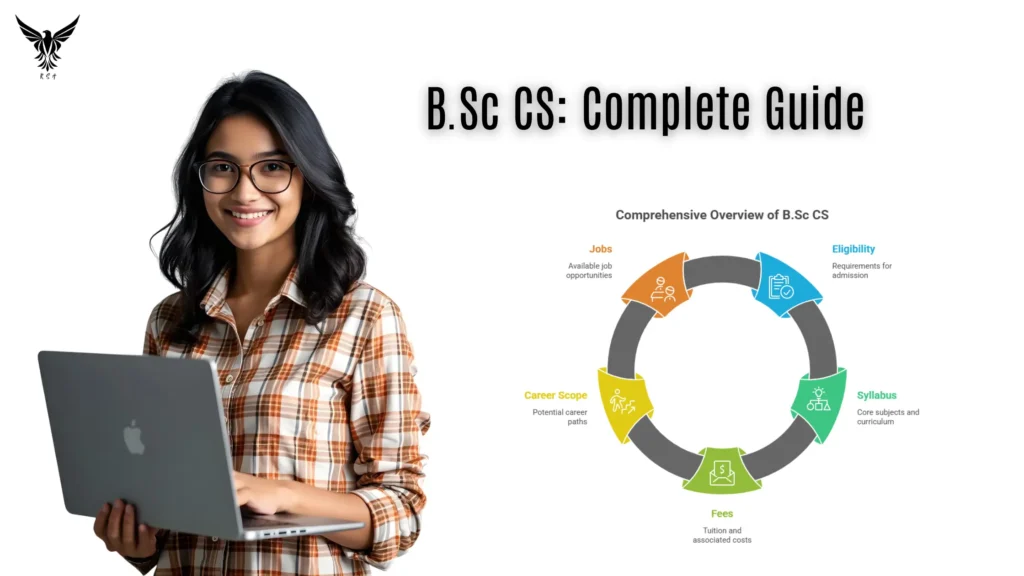

- What is B.Sc CS?
- Why Choose B.Sc CS?
- B.Sc CS Course Highlights
- B.Sc CS Eligibility Criteria
- B.Sc CS Admission Process
- 1. Merit-Based Admission
- 2. Entrance Exam-Based Admission
- 3. Online Application
- B.Sc CS Syllabus and Subjects
- Semester 1
- Semester 2
- Semester 3
- Semester 4
- Semester 5
- Semester 6
- B.Sc CS Fees Structure
- Top Colleges Offering B.Sc CS in India
- Skills Required for B.Sc CS Students
- Career Scope After B.Sc CS
- Job Roles After B.Sc CS
- Salary After B.Sc CS
- Higher Studies After B.Sc CS
- B.Sc CS vs BCA: Which is Better?
- Future Scope of B.Sc CS
- Advantages of Studying B.Sc CS
- Challenges of B.Sc CS
- Who Should Choose B.Sc CS?
- Final Thoughts
- FAQs on B.Sc CS
- 1. What is B.Sc CS?
- 2. Who is eligible for B.Sc CS?
- 3. What is the duration of the B.Sc CS course?
- 4. Is B.Sc CS better than BCA?
- 5. What subjects are taught in B.Sc CS?
- 6. What is the average fee for B.Sc CS?
- 7. What are the career options after B.Sc CS?
- 8. What is the salary after B.Sc CS?
- 9. Can I do MCA after B.Sc CS?
- 10. Is B.Sc CS a good career choice in the future?
- B.Sc CS vs B.Tech CS: Which is Better for Your Career?
- B.Sc CS vs B.Tech CS (Short Comparison)
- Final Tip:
In today’s digital era, computers and technology have become an inseparable part of every industry. From education and healthcare to finance and entertainment, computer science plays a crucial role in driving innovation. Among the most popular undergraduate programs in this domain is B.Sc CS (Bachelor of Science in Computer Science). This course is designed to provide students with strong theoretical knowledge and practical skills in computing, programming, and software development.
This detailed article covers everything you need to know about B.Sc CS, including course details, eligibility, syllabus, admission process, fees, top colleges, career opportunities, salary, and future scope.
What is B.Sc CS?
B.Sc CS stands for Bachelor of Science in Computer Science, a three-year undergraduate degree focused on the study of computers, software systems, programming languages, data structures, algorithms, databases, networking, and emerging technologies.
The main objective of the B.Sc CS course is to build a strong foundation in computer science principles while developing problem-solving, analytical, and programming skills. It is an ideal course for students who have an interest in technology, coding, and logical thinking.
Why Choose B.Sc CS?
Choosing B.Sc CS can be a smart decision for students who want a career in the IT and software industry. Here are some key reasons why this course is highly popular:
- Strong foundation in computer science concepts
- High demand for computer science graduates
- Wide range of career opportunities
- Suitable for both technical and research-oriented roles
- Excellent base for higher studies like MCA, M.Sc CS, or MBA
With digital transformation accelerating across industries, the demand for B.Sc CS graduates continues to grow year after year.
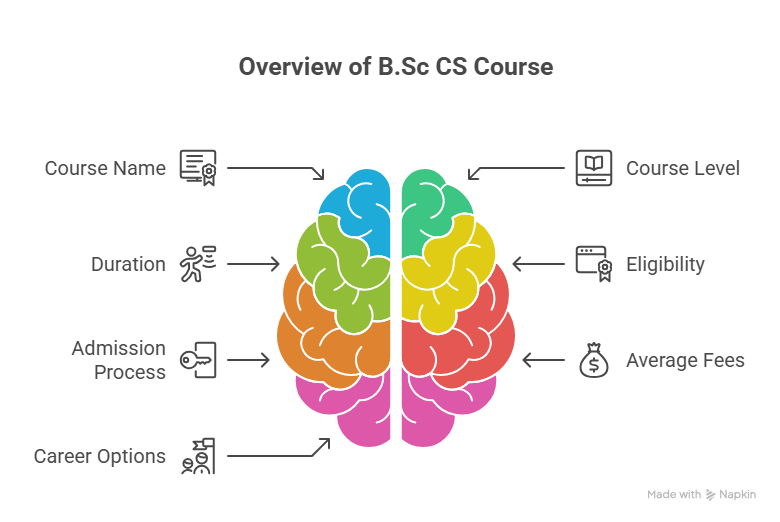
B.Sc CS Course Highlights
| Feature | Details |
|---|---|
| Course Name | B.Sc CS |
| Full Form | Bachelor of Science in Computer Science |
| Course Level | Undergraduate |
| Duration | 3 Years (6 Semesters) |
| Eligibility | 10+2 with Mathematics |
| Admission Process | Merit / Entrance Exam |
| Average Fees | ₹20,000 – ₹1,50,000 per year |
| Career Options | Software Developer, Data Analyst, System Engineer |
B.Sc CS Eligibility Criteria
To get admission into B.Sc CS, candidates must meet the following eligibility requirements:
- Must have passed 10+2 (Class 12) from a recognized board
- Mathematics is compulsory in Class 12
- Some colleges also require Physics or Computer Science
- Minimum marks usually range between 45% to 60%, depending on the institution
Students from Science stream (PCM/PCMB) are preferred for B.Sc CS admission.
B.Sc CS Admission Process
The admission process for B.Sc CS varies from college to college. Generally, admission is offered through the following methods:
1. Merit-Based Admission
Many colleges provide admission based on Class 12 marks, especially in Mathematics.
2. Entrance Exam-Based Admission
Some universities conduct entrance exams or consider scores from university-level tests.
3. Online Application
Candidates need to fill the application form online, upload documents, and pay the application fee.
B.Sc CS Syllabus and Subjects
The B.Sc CS syllabus is designed to cover both theoretical concepts and practical applications. Below is a general semester-wise syllabus structure:
Semester 1
- Introduction to Computer Science
- Programming in C
- Mathematics I
- Digital Logic
- Communication Skills
Semester 2
- Data Structures
- Object-Oriented Programming (C++/Java)
- Mathematics II
- Computer Organization
- Environmental Studies
Semester 3
- Operating Systems
- Database Management Systems (DBMS)
- Python Programming
- Software Engineering
- Statistics
Semester 4
- Computer Networks
- Web Development
- Design and Analysis of Algorithms
- Java Programming
- Practical Lab
Semester 5
- Artificial Intelligence
- Data Science Basics
- Mobile Application Development
- Cloud Computing
- Mini Project
Semester 6
- Machine Learning
- Cyber Security
- Big Data Analytics
- Major Project / Internship
The B.Sc CS syllabus may vary slightly depending on the university or college.
B.Sc CS Fees Structure
The fees for B.Sc CS depend on the type of institution:
| College Type | Average Annual Fees |
|---|---|
| Government Colleges | ₹20,000 – ₹40,000 |
| Private Colleges | ₹60,000 – ₹1,50,000 |
| Deemed Universities | ₹80,000 – ₹2,00,000 |
Scholarships and fee waivers are available for meritorious and reserved category students.
Top Colleges Offering B.Sc CS in India
Some well-known colleges and universities offering B.Sc CS include:
- St. Xavier’s College
- Loyola College
- Christ University
- Hindu College
- Fergusson College
- Presidency College
- Madras Christian College
Admission cut-offs vary based on college reputation and demand.
Skills Required for B.Sc CS Students
To succeed in B.Sc CS, students should develop the following skills:
- Programming and coding skills
- Logical and analytical thinking
- Problem-solving ability
- Understanding of algorithms and data structures
- Communication and teamwork skills
- Adaptability to new technologies
Career Scope After B.Sc CS
One of the biggest advantages of B.Sc CS is its wide career scope. Graduates can work in both private and government sectors.
Job Roles After B.Sc CS
- Software Developer
- Web Developer
- Data Analyst
- System Analyst
- Database Administrator
- Network Engineer
- Cyber Security Analyst
- Technical Support Engineer
Salary After B.Sc CS
The salary after B.Sc CS depends on skills, experience, and job role.
| Experience Level | Average Salary |
|---|---|
| Fresher | ₹3 – ₹5 LPA |
| 2–4 Years | ₹6 – ₹10 LPA |
| Experienced Professionals | ₹12 LPA and above |
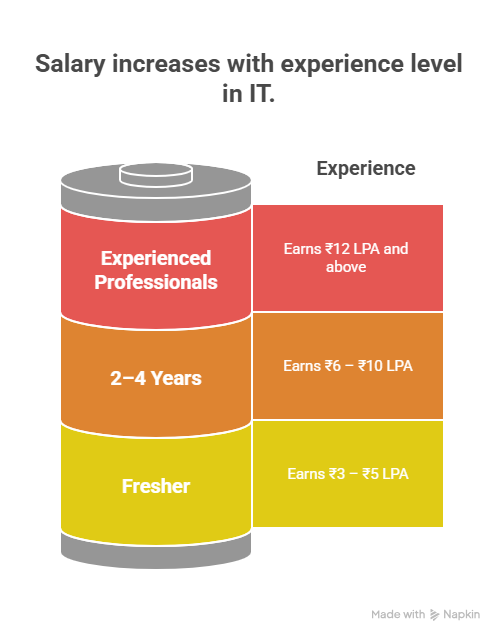
With specialization in fields like AI, Data Science, or Cyber Security, salaries can increase significantly.
Higher Studies After B.Sc CS
After completing B.Sc CS, students can pursue higher education to enhance career prospects:
- M.Sc Computer Science
- MCA (Master of Computer Applications)
- MBA (IT / Systems / Analytics)
- PG Diploma in Data Science / AI / Cloud Computing
- International Certifications
Higher studies open doors to advanced roles and leadership positions.
B.Sc CS vs BCA: Which is Better?
| Parameter | B.Sc CS | BCA |
|---|---|---|
| Focus | Theoretical + Practical | Application-Oriented |
| Duration | 3 Years | 3 Years |
| Eligibility | 10+2 with Math | 10+2 (Math preferred) |
| Career Scope | IT, Research, Academia | IT & Software Development |
Both courses are good, but B.Sc CS is often preferred for research and technical depth.
Future Scope of B.Sc CS
The future of B.Sc CS is extremely promising due to rapid technological advancements. Emerging areas like Artificial Intelligence, Machine Learning, Blockchain, Cloud Computing, and Cyber Security are creating massive job opportunities.
With continuous upskilling, B.Sc CS graduates can build long-term, high-paying careers in India and abroad.
Advantages of Studying B.Sc CS
- Strong academic foundation
- High employability
- Versatile career options
- Suitable for tech and non-tech industries
- Opportunity to work globally
Challenges of B.Sc CS
- Requires continuous learning
- Competitive job market
- Demands strong logical thinking
- Rapidly changing technology
However, students who stay updated can overcome these challenges easily.
Who Should Choose B.Sc CS?
B.Sc CS is ideal for students who:
- Love computers and technology
- Enjoy coding and problem-solving
- Want a career in IT or software development
- Are interested in emerging technologies
Final Thoughts
B.Sc CS is one of the most valuable and future-oriented undergraduate programs in today’s digital world. It provides students with a solid foundation in computer science and opens doors to numerous career opportunities across industries. Whether you plan to work after graduation or pursue higher studies, B.Sc CS offers flexibility, stability, and growth.
If you are passionate about technology and want a strong start in the IT domain, choosing B.Sc CS can be a life-changing decision.
FAQs on B.Sc CS
1. What is B.Sc CS?
B.Sc CS stands for Bachelor of Science in Computer Science. It is a 3-year undergraduate degree that focuses on computer programming, software development, data structures, databases, and emerging technologies.
2. Who is eligible for B.Sc CS?
Candidates must have passed 10+2 with Mathematics from a recognized board. Some colleges also require Physics or Computer Science with a minimum of 45–60% marks.
3. What is the duration of the B.Sc CS course?
The duration of B.Sc CS is 3 years, divided into 6 semesters.
4. Is B.Sc CS better than BCA?
Both courses are good. B.Sc CS focuses more on theoretical and technical foundations, while BCA is more application-oriented. B.Sc CS is often preferred for research and higher studies.
5. What subjects are taught in B.Sc CS?
Major subjects include Programming in C/C++/Java, Data Structures, DBMS, Operating Systems, Computer Networks, Python, AI, and Web Development.
6. What is the average fee for B.Sc CS?
The average annual fee for B.Sc CS ranges from ₹20,000 to ₹1.5 lakh, depending on whether the college is government or private.
7. What are the career options after B.Sc CS?
After B.Sc CS, students can work as Software Developer, Web Developer, Data Analyst, System Engineer, Network Administrator, or Cyber Security Analyst.
8. What is the salary after B.Sc CS?
Freshers usually earn ₹3–5 LPA. With experience and specialization, salaries can go up to ₹10–15 LPA or more.
9. Can I do MCA after B.Sc CS?
Yes, B.Sc CS graduates are eligible for MCA, M.Sc Computer Science, MBA, and other postgraduate programs.
10. Is B.Sc CS a good career choice in the future?
Yes, B.Sc CS has an excellent future scope due to high demand in IT, data science, AI, cloud computing, and cyber security fields.
B.Sc CS vs B.Tech CS: Which is Better for Your Career?
Choosing between B.Sc CS and B.Tech CS is one of the most common dilemmas for students interested in computer science. Both courses lead to promising careers in the IT and technology sector, but they differ in course structure, eligibility, fees, and career approach. This comparison will help you decide which option suits your goals better.
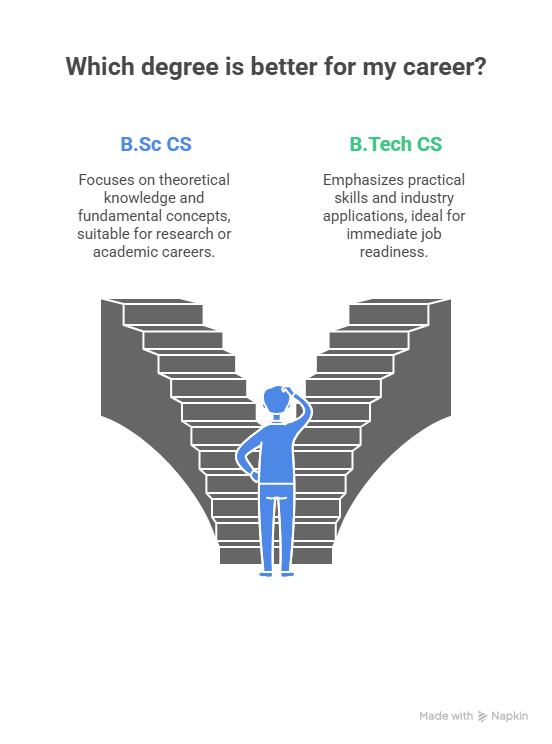
B.Sc CS vs B.Tech CS (Short Comparison)
| Feature | B.Sc CS | B.Tech CS |
|---|---|---|
| Duration | 3 Years | 4 Years |
| Course Type | Science Degree | Engineering Degree |
| Eligibility | 10+2 with Maths | 10+2 with PCM |
| Focus | Programming & Theory | Engineering & Advanced Tech |
| Admission | Merit / Entrance | JEE & Other Exams |
| Fees | Lower | Higher |
| Salary (Fresher) | ₹3–5 LPA | ₹4–8 LPA |
| Best For | Research, MCA, M.Sc | Core Engineering Jobs |
Final Tip:
Choose B.Sc CS for affordability and flexibility.
Choose B.Tech CS for engineering roles and higher placement exposure.