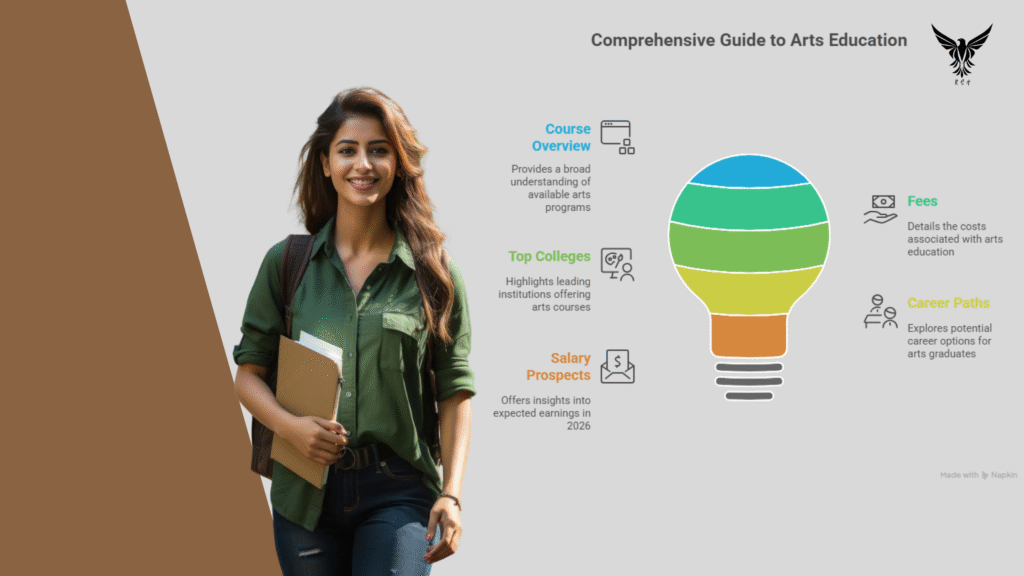

A Comprehensive Guide
This document provides a comprehensive overview of studying Arts, covering various aspects such as degree options, specializations, eligibility criteria, entrance tests, top colleges, fees, scholarships, and career prospects. It aims to guide prospective students in making informed decisions about pursuing an education.
Degrees in Arts
The field of Arts offers a diverse range of degree programs, catering to various interests and career aspirations. Some of the most popular Arts degrees include:
- Bachelor of Arts (BA): A broad-based undergraduate degree that allows students to explore various subjects in the humanities, social sciences, .
- Bachelor of Fine Arts (BFA): A specialized undergraduate degree that focuses on developing artistic skills and techniques in areas such as painting, sculpture, photography, and graphic design.
- Bachelor of Performing Arts (BPA): A degree that emphasizes the study and practice of performing arts such as music, dance, and theatre.
- Master of Arts (MA): A postgraduate degree that allows students to delve deeper into a specific area of study .
- Master of Fine Arts (MFA): A terminal degree this, often required for teaching at the university level or pursuing a professional career as an artist.
- Doctor of Philosophy (PhD): A research-oriented doctoral degree that prepares students for careers in academia and research.
Specializations
Within each degree program, students can choose to specialize in a particular area of interest. Some common specializations in this include:
- Humanities: Literature, History, Philosophy, Religious Studies, Languages, Linguistics
- Social Sciences: Sociology, Psychology, Political Science, Economics, Anthropology, Geography
- Fine Arts: Painting, Sculpture, Photography, Graphic Design, Ceramics, Printmaking
- Performing Arts: Music, Dance, Theatre, Film, Television
- Communication and Media Studies: Journalism, Public Relations, Advertising, Film Studies, Digital Media
Eligibility Criteria
The eligibility criteria programs vary depending on the institution and the degree level. Generally, the following criteria apply:
- Undergraduate Programs (BA, BFA, BPA): Completion of 10+2 (or equivalent) from a recognized board with a minimum aggregate score. Some institutions may also require specific subjects in 10+2 depending on the specialization.
- Postgraduate Programs (MA, MFA): A bachelor’s degree in a relevant field from a recognized university with a minimum aggregate score. Some institutions may also require a portfolio or audition for Fine Arts and Performing this.
- Doctoral Programs (PhD): A master’s degree in a relevant field from a recognized university with a strong academic record.
Entrance Tests
Many top Arts colleges and universities conduct entrance tests to assess the aptitude and skills of prospective students. Some common entrance tests for this include:
- Common University Entrance Test (CUET): A national-level entrance test for admission to undergraduate programs in central universities across India.
- Delhi University Entrance Test (DUET): Conducted by Delhi University for admission to various undergraduate and postgraduate programs.
- Banaras Hindu University Undergraduate Entrance Test (BHU UET): Conducted by Banaras Hindu University for admission to undergraduate programs.
- Jamia Millia Islamia Entrance Test (JMI Entrance Test): Conducted by Jamia Millia Islamia for admission to various undergraduate and postgraduate programs.
- National Aptitude Test in Architecture (NATA): Required for admission to Bachelor of Architecture (B.Arch) programs.
- Portfolio/Audition: Many programs and Performing require candidates to submit a portfolio of their work or participate in an audition.
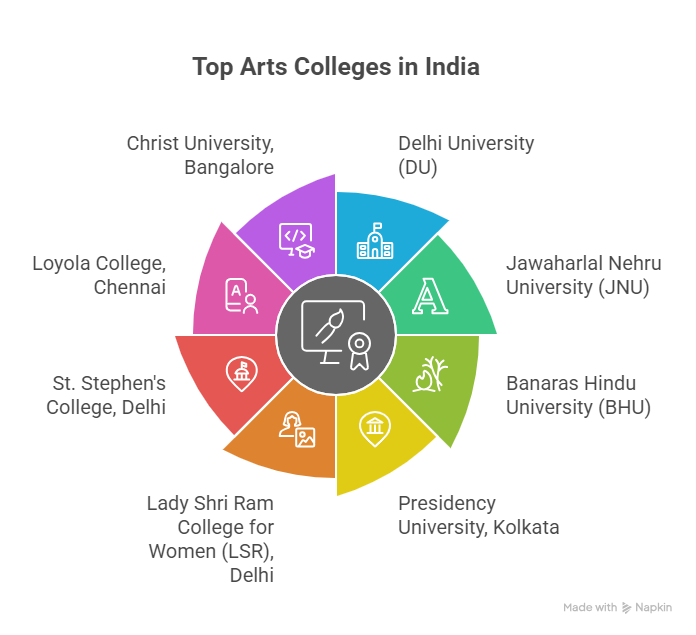
Top Colleges for Arts
India boasts a number of prestigious institutions offering excellent Arts programs. Some of the top colleges in India include:
- Lady Shri Ram College for Women (LSR), Delhi: Renowned for its humanities and social sciences programs.
- Hindu College, Delhi: Offers a wide range of a strong emphasis on research.
- Miranda House, Delhi: A leading women’s college with excellent Science programs.
- St. Stephen’s College, Delhi: Known for its rigorous academic environment and strong alumni network.
- Presidency College, Kolkata: A historic institution with a strong reputation
- Loyola College, Chennai: Offers a diverse range of programs with a focus on holistic development.
- Fergusson College, Pune: A well-known college with a strong faculty and a vibrant campus culture.
- National School of Drama (NSD), Delhi: Premier institution for theatre education.
- Faculty of Fine Arts, MS University, Baroda: Renowned for its this programs.
Fees
The fees vary depending on the institution, the degree level, and the specialization. Government-funded colleges and universities generally have lower fees compared to private institutions. The annual fees for undergraduate can range from INR 5,000 to INR 50,000 in government colleges and INR 20,000 to INR 2,00,000 in private colleges. Postgraduate programs typically have higher fees.
Scholarships
Numerous scholarships are available to support students pursuing education. These scholarships can be based on merit, financial need, or specific categories such as students from minority communities or students with disabilities. Some popular scholarships for students include:
- National Scholarship Portal (NSP): A government portal that provides information on various scholarships offered by the central and state governments.
- University Grants Commission (UGC) Scholarships: UGC offers various scholarships for postgraduate and doctoral students.
- Private Scholarships: Many private organizations and foundations offer scholarships to students.
- College-Specific Scholarships: Many colleges and universities offer scholarships to their students based on merit or financial need.
Career Prospects
This education can open doors to a wide range of career opportunities. Some common career paths for graduates include:
- Teaching and Academia: Lecturers, Professors, Researchers
- Journalism and Media: Journalists, Editors, Content Writers, Public Relations Specialists, Advertising Professionals
- Creative Industries: Artists, Designers, Musicians, Actors, Filmmakers, Writers
- Cultural Heritage: Museum Curators, Archivists, Historians
- Social Work and Community Development: Social Workers, Counselors, Community Organizers
- Government and Public Service: Civil Servants, Policy Analysts
- Business and Management: Human Resources, Marketing, Communications
The specific career prospects will depend on the student’s specialization, skills, and experience. Internships, volunteer work, and extracurricular activities can significantly enhance career prospects for graduates.

In conclusion, studying this offers a diverse and rewarding educational experience. By carefully considering their interests, skills, and career goals, prospective students can choose the right degree program, specialization, and institution to pursue their passion and achieve their professional aspirations.
FAQ – Arts Course: Courses, Fees, Colleges, Careers & Salary (2026)
An Arts course focuses on subjects related to humanities, social sciences, languages, communication, and fine arts. Popular streams include Psychology, Sociology, English, History, Political Science, Economics, Philosophy, and Journalism.
Popular Arts courses in 2026 include:
• BA in Psychology
• BA in English / Literature
• BA in Economics
• BA in Journalism & Mass Communication
• BA in Political Science
• BA in Sociology
• Fine Arts (BFA)
• BA LLB (Integrated)
• BA in Tourism & Hospitality
Fees vary by college type:
• Government Colleges: ₹5,000 – ₹25,000 per year
• Private Colleges: ₹25,000 – ₹1,50,000 per year
• Top Private Universities: ₹1,50,000 – ₹3,00,000 per year
Top Arts colleges include:
• Miranda House, Delhi
• St. Stephen’s College, Delhi
• Hindu College, Delhi University
• Loyola College, Chennai
• Christ University, Bangalore
• Presidency University, Kolkata
• St. Xavier’s College, Mumbai
• Lady Shri Ram College (LSR)
Career options include:
• Psychologist / Counsellor
• Journalist / News Reporter
• Content Writer / Editor
• Teacher / Lecturer
• Social Worker
• Marketing Executive
• Lawyer (after BA LLB)
• Civil Services (IAS, IPS, etc.)
• Graphic Designer / Artist
• Digital Marketer
Average salary ranges by field:
• Journalism: ₹3 – 6 LPA
• Psychology: ₹4 – 8 LPA
• Teaching: ₹3 – 5 LPA
• Content Writing: ₹3 – 7 LPA
• Marketing / HR: ₹4 – 8 LPA
• Civil Services: ₹8 – 15 LPA (after selection)