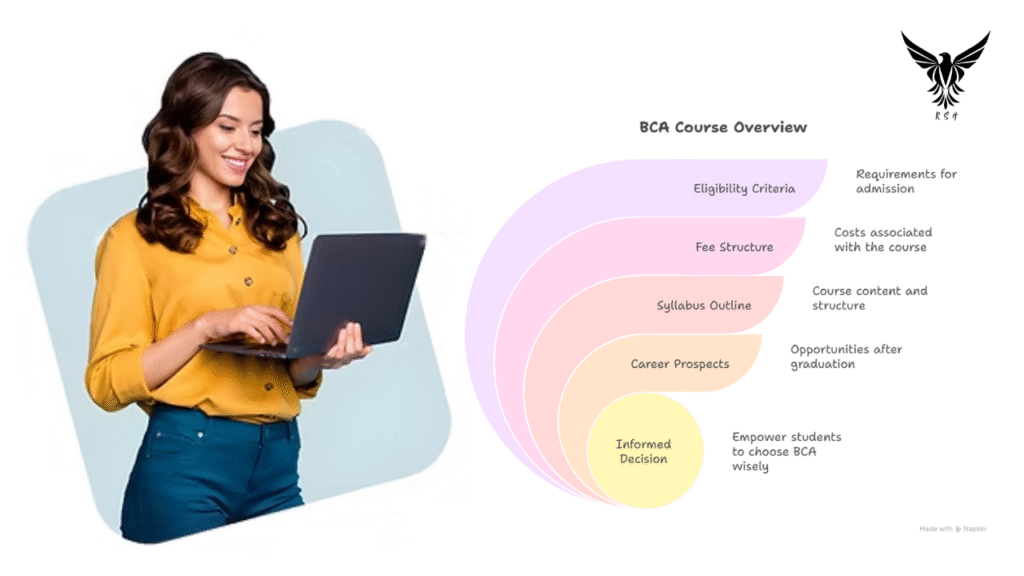

This document provides a comprehensive overview of the (BCA )Bachelor of Computer Applications (BCA) course. It covers essential aspects such as eligibility criteria, typical fee structures, a detailed syllabus outline, and potential career prospects after graduation. This guide aims to equip prospective students with the necessary information to make informed decisions about pursuing a BCA degree.
Eligibility Criteria
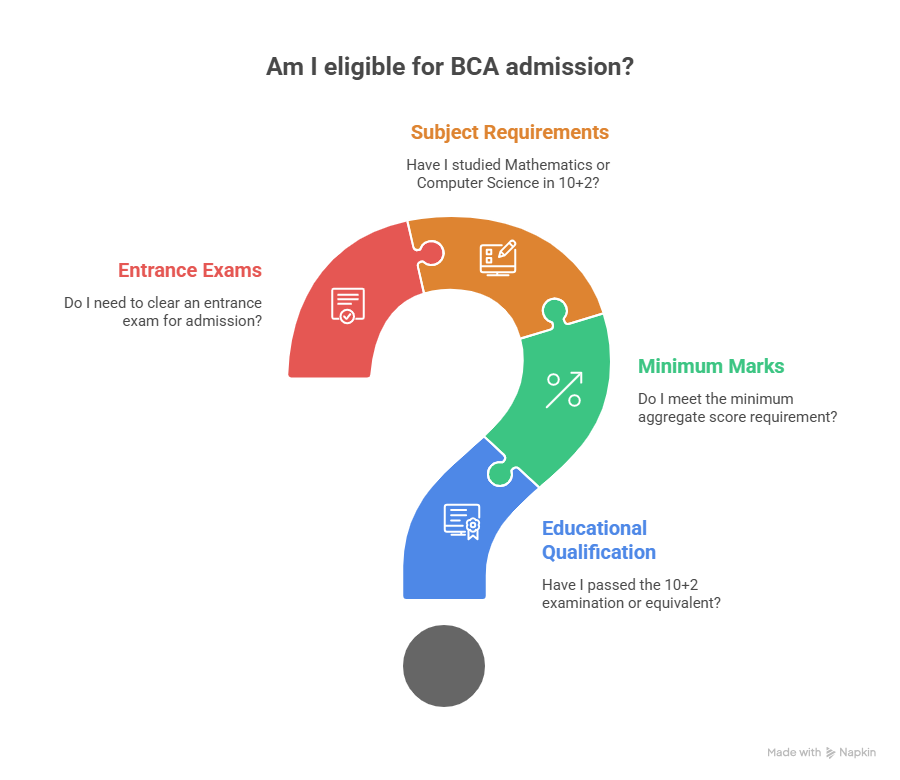
The eligibility criteria for a BCA program typically include the following:
- Educational Qualification: Candidates must have passed the 10+2 examination (or equivalent) from a recognized board.
- Minimum Marks: A minimum aggregate score is usually required, often around 45% to 50%. This percentage can vary depending on the institution.
- Subject Requirements: While not always mandatory, some colleges may require candidates to have studied Mathematics or Computer Science as subjects in their 10+2.
- Entrance Exams: Certain universities and colleges conduct their own entrance exams for BCA admissions. Clearing these exams is a prerequisite for admission.
It is crucial to check the specific eligibility criteria of the college or university you are interested in, as requirements can differ.
Fee Structure
The fee structure for a BCA program varies significantly based on several factors:
- Type of Institution: Government colleges generally have lower fees compared to private colleges and universities.
- Location: Colleges in metropolitan cities tend to have higher fees than those in smaller towns or rural areas.
- Infrastructure and Facilities: Institutions with better infrastructure, advanced labs, and experienced faculty often charge higher fees.
- Reputation and Ranking: Highly ranked and reputed colleges usually have a higher fee structure.
On average, the annual fees for a BCA program can range from INR 30,000 to INR 1,50,000 or even higher in some private institutions. It’s advisable to visit the official website of the respective college or contact the admissions office for accurate and updated fee information.
Syllabus Outline
The BCA syllabus is designed to provide students with a strong foundation in computer science and its applications. The curriculum typically covers a wide range of subjects, including:
Year 1:
- Computer Fundamentals: Introduction to computers, hardware, software, operating systems, and basic computer concepts.
- Programming in C: Fundamentals of C programming language, data types, operators, control structures, functions, and arrays.
- Mathematics: Discrete Mathematics, Calculus, and Statistics.
- Digital Electronics: Basic concepts of digital circuits, logic gates, Boolean algebra, and combinational circuits.
- Communication Skills: English language proficiency, communication techniques, and presentation skills.
- Database Management Systems (DBMS): Introduction to database concepts, data models, relational algebra, and SQL.
Year 2:
- Object-Oriented Programming (OOP) using C++: Concepts of OOP, classes, objects, inheritance, polymorphism, and data abstraction.
- Data Structures: Arrays, linked lists, stacks, queues, trees, and graphs.
- Operating Systems: Principles of operating systems, process management, memory management, and file systems.
- Software Engineering: Software development life cycle (SDLC), requirements analysis, design, testing, and maintenance.
- Web Technologies: HTML, CSS, JavaScript, and basic web development concepts.
- Computer Networks: Introduction to networking, network topologies, protocols, and the OSI model.
Year 3:
- Java Programming: Core Java concepts, object-oriented programming in Java, exception handling, multithreading, and collections.
- Database Management Systems (Advanced): Database design, normalization, transaction management, and database security.
- Web Development (Advanced): Server-side scripting (e.g., PHP, Python), database integration, and web frameworks.
- Computer Graphics: Introduction to computer graphics, 2D and 3D transformations, and rendering techniques.
- Artificial Intelligence (AI): Introduction to AI, machine learning, natural language processing, and expert systems.
- Project Work: Students are typically required to undertake a project in their final year, applying the knowledge and skills they have acquired throughout the course.
Note: This is a general outline, and the specific subjects and their content may vary depending on the university or college.
Career Prospects
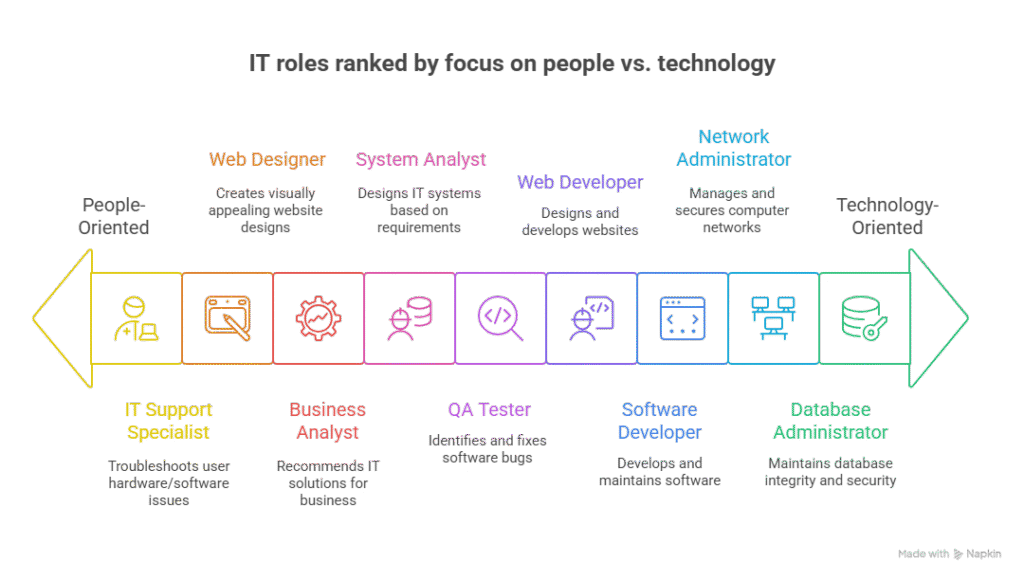
A BCA degree opens up a wide range of career opportunities in the IT sector. Some of the popular career paths for BCA graduates include:
- Software Developer: Developing and maintaining software applications for various platforms.
- Web Developer: Designing and developing websites and web applications.
- Database Administrator: Managing and maintaining databases, ensuring data integrity and security.
- System Analyst: Analyzing user requirements and designing IT systems to meet those needs.
- Network Administrator: Managing and maintaining computer networks, ensuring network security and performance.
- IT Support Specialist: Providing technical support to users, troubleshooting hardware and software issues.
- Web Designer: Creating visually appealing and user-friendly website designs.
- Quality Assurance (QA) Tester: Testing software applications to identify and fix bugs.
- Business Analyst: Analyzing business processes and recommending IT solutions to improve efficiency.
- Data Scientist: Analyzing large datasets to extract insights and make data-driven decisions (often requires further education).
Furthermore, a BCA degree can serve as a foundation for pursuing higher education, such as an MCA (Master of Computer Applications) or an MBA (Master of Business Administration), which can further enhance career prospects.
Skills Acquired
During the BCA course, students acquire a variety of technical and soft skills that are highly valued in the IT industry. These include:
- Programming Skills: Proficiency in programming languages such as C, C++, Java, and Python.
- Database Management Skills: Knowledge of database concepts, SQL, and database management systems.
- Web Development Skills: Expertise in HTML, CSS, JavaScript, and web development frameworks.
- Problem-Solving Skills: Ability to analyze problems and develop effective solutions.
- Analytical Skills: Ability to analyze data and extract meaningful insights.
- Communication Skills: Ability to communicate effectively with technical and non-technical audiences.
- Teamwork Skills: Ability to work effectively in a team environment.
- Critical Thinking Skills: Ability to think critically and make informed decisions.
Conclusion
The BCA program is a valuable option for students seeking a career in the IT sector. By understanding the eligibility criteria, fee structure, syllabus, and career prospects, prospective students can make an informed decision about pursuing this degree. The skills and knowledge acquired during the BCA course provide a strong foundation for a successful career in the ever-evolving world of technology. Remember to research specific colleges and universities to find the program that best suits your individual needs and career goals.