
CLAT 2026 One of the most significant national-level exams of students who want to pursue a career in law is the Common Law Admission Test (CLAT) 2026. Administered by the Consortium of National Law Universities (NLUs), CLAT is the point of entry to the undergraduate (UG) and postgraduate (PG) programs in the reputable NLUs around the nation. This exam is one of the most competitive entrance tests in India as thousands of candidates sit down to take this exam every year.
CLAT 2026 – Important Dates
| Event | Date | Details |
|---|---|---|
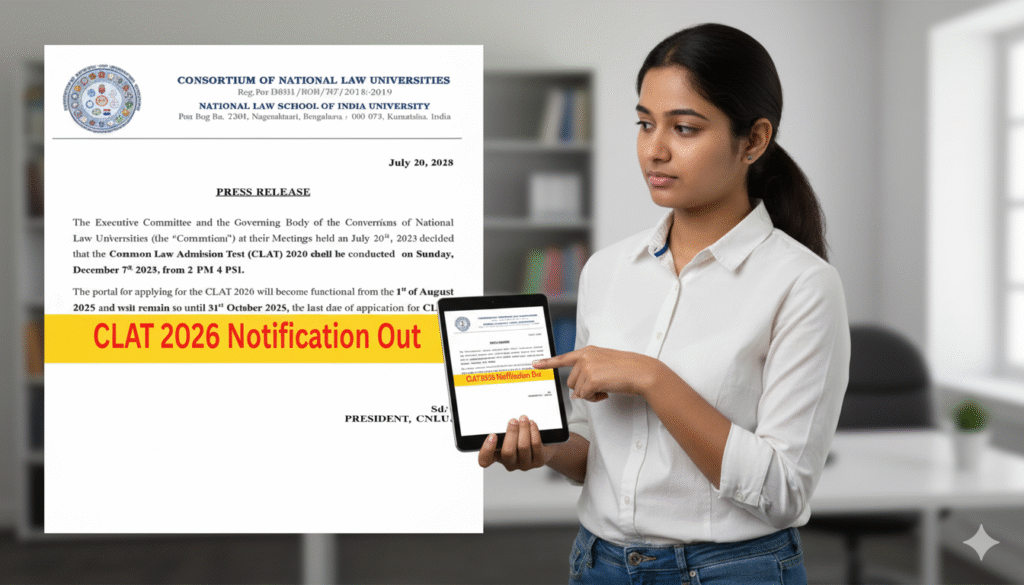
| Release of Official Notification | July 20, 2025 | Consortium of NLUs announces CLAT 2026 schedule and guidelines. |
| Start of Online Registration | August 1, 2025 | Application form made available on the official website. |
| Last Date to Apply | October 31, 2025 | Final deadline for submission of online applications. |
| Admit Card Release | November 2025 (Tentative) | Downloadable from the official CLAT portal. |
| CLAT 2026 Exam Date | December 7, 2025 (Sunday) | Conducted in offline, pen-and-paper mode from 2:00 PM to 4:00 PM. |
| Provisional Answer Key Release | December 2025 (Mid-Month) | Candidates can raise objections within a limited time window. |
| Final Answer Key & Result Declaration | December 2025 (End) | Final results published with all corrections. |
| Counselling & Seat Allotment | December 2025 – January 2026 | Online counselling process begins for admission to NLUs. |
Registration and Important Dates.
The Consortium of NLUs has already published the official notification of CLAT 2026. Registration started on August 1, 2025, and the deadline to apply is October 31, 2025. The applicants may get registered online on the official consortium web site. CLAT 2026 will take place on December 7, 2025, at 2 PM to 4 PM, the test will be online (pen-and-paper-based). It is recommended that the applicants get the process completed much ahead of time to avoid technical hitches at the last minute.
Eligibility Requirement and Application Charge.
In the case of the undergraduate (UG) CLAT examination, one needs to have passed the 10 +2 or similar examination administered by a recognized board. Students who will be enrolled in the Class 12 exams by 2026 can apply as well. In the case of postgraduate (PG) CLAT exam, a candidate should have a degree course in Law (LL.B. degree) or any other program or equivalent degree awarded by a recognized university. Minimal percentage required depends on category which is usually about 45 percent in case of General/ OBC candidates and 40 percent in case of ST/SC candidates. Application fee is 4000 INR amongst General/OBC and 3500 INR amongst SC/ST/BPL/PwD.
Exam Pattern and Mode of Examination.
The CLAT 2026 will be used in offline mode, and the duration will be two hours. The UG exam is purely composed of multiple question samples (MCQs), which challenge the understanding and reasoning skills of the candidates as opposed to the memorization skills. The major areas are English language, current affairs with general knowledge, legal reasoning, logical reasoning and quantitative techniques. Questions are scored on a mark basis with each question having one mark and having a negative score of 0.25 when one gives wrong answers. One must have a good grasp of every area of subject and practise it frequently to be a good performer.
Detailed Syllabus Overview
The English Language part evaluates reading, vocabulary, grammar and inferential reasoning. Current Affairs and General Knowledge will include the recent events, awards, government policies, international affairs, and sports. Legal Reasoning is an examination of the skills of the candidate in applying the rules of law and examining situations based on facts. Logical Reasoning incorporates such topics as argument analysis, analogy, logical sequence, and reason by pattern. Finally, there are Quantitative Techniques, which are basics of mathematics, chart interpretation, and calculations which rely on data. Paying attention to each of the sections makes the preparation very balanced.
Application Process and Documentation.
The candidates are then required to visit the official CLAT site in order to complete the application form. They are expected to carry the scanned photos, signature and other needed certificates before beginning. One should make sure that every information is right because in case of misinformation, he/she can be disqualified. Once the applicants fill the form and pay the fee, they are supposed to save the confirmation page and save it in order to refer to it later on. It will be easy to keep all the documents organized to assist during the admission and counselling stages.
Plans of CLAT 2026 Preparation.
Preparation in CLAT involves being smart and working hard. Start preparations early and allocate certain time per day to every part. Frequently reading newspapers and magazines can be used to develop knowledge of the Current Affairs section. Comprehension passages help enhance speed and accuracy in reading English section. In the case of Legal Reasoning, it is important to learn the fundamental concepts of the law and the past paper. Logical and Quantitative sections need to be practiced in form of mock tests in order to practice and get faster and more accurate. Structured guidance can also be offered by joining a coaching institute or by means of using online resources.
Post Exam Process and Counselling.
The consortium will publish the provisional answer key in a few days after the CLAT 2026 exam. Applicants will be given a chance to object to the final answer key and results announced. On the basis of merit list short-listed candidates will be called in terms of counselling and seat allotment. The process of counselling is likely to start in the period of December 2025 and proceed to January 2026. The applicants are expected to pay thorough attention to choosing their desired NLUs and send required documents at this stage.
In order to make the aspirant and reader find all the necessary information quickly, this blog puts special attention to the key points of CLAT 2026, such as the CLAT 2026 notification, where the official announcement of exam time is provided, and to CLAT 2026 registration, during which the candidates are guided through the online application form. We also discuss the date of CLAT 2026 exam, which will allow students to put it on their calendars and the CLAT 2026 syllabus, which will emphasize on the subjects and topics that will be covered. The pattern of the CLAT 2026 exam is also critical because it gives one an idea of how the questions are distributed and how they are marked. To the early planners, we have provided CLAT 2026 preparation tips which revolve around strategy, time management and suggested study material. Students will have an opportunity to verify the CLAT 2026 answer key and CLAT 2026 result date to evaluate the performance and rankings. Lastly, the advice on the CLAT 2026 counselling procedure facilitates the candidates in a seamless transition to the next step admission phase in the top National Law Universities.
Conclusion
CLAT 2026 is a golden ticket to the potential law students of India to get admission in the most prestigious law university of India. Aspirants should now concentrate on disciplined preparations now that the registration process is already in progress and the exam is scheduled on December 7, 2025. Having a clear idea about the syllabus, proper time management and practising with the fake exams are the main key to success. It is not far out of your reach, and with hard work and clever tact, you can make it to CLAT 2026.